A discrete framework in which spacetime, gravity, and physical constants emerge from Planck-scale coherence.
The Sobolev–Ozok Lattice (SOL) proposes that physical reality is built from discrete cells whose coherence and resolution dynamics generate geometry, motion, and structure across scales.
Instead of assuming spacetime as a continuous background, SOL treats it as an emergent result of local interactions. The framework is developed to connect quantum behavior, gravitational structure, cosmology, and particle-scale organization within one discrete picture.
Start here
If this is your first time visiting the project, this is the shortest way to understand what SOL is trying to do.
1. Core premise
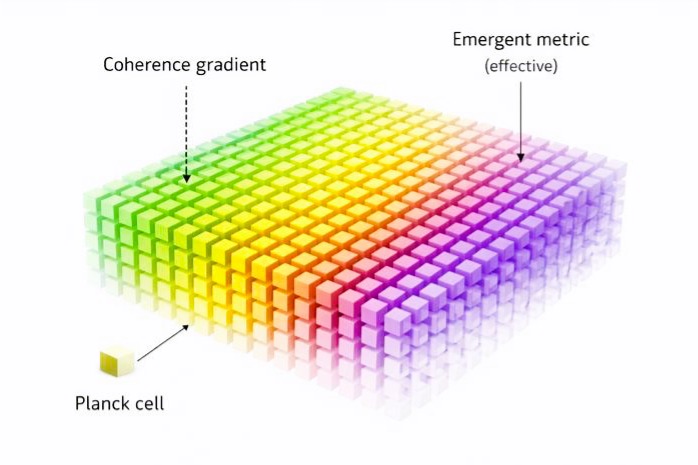
Spacetime is modeled as a discrete lattice of Planck-scale cells rather than a fundamentally continuous arena.
2. Generating geometry
Coherence gradients between cells produce an effective geometric structure, so curvature is treated as emergent.
3. Physical behavior
Quantum and large-scale behavior arise from resolution dynamics, coherence structure, and their higher-order corrections.
Why SOL is different
Not just another abstract description
- It starts from a discrete cell picture at the Planck scale.
- It treats geometry as a result of coherence rather than a prior stage.
- It aims to derive structure, not only fit observations afterward.
Built around falsifiability
- Planetary precession and solar-system tests
- Galaxy rotation behavior
- Black hole and shadow-related phenomena
- Higher-order coherence corrections beyond leading behavior
What the framework aims to explain
Choose your reading path
Different visitors need different entry points. Use the path that matches your level of interest.
Understand the idea
Get the conceptual overview of the framework, its motivation, and its main physical picture.
Read philosophySee the testable side
Review the observational hooks, falsifiability, and the phenomena SOL claims should be distinguishable.
Open predictionsGo technical
Access the papers and manuscripts, including archived Zenodo records and ongoing theoretical development.
Browse papersCore conceptual structure
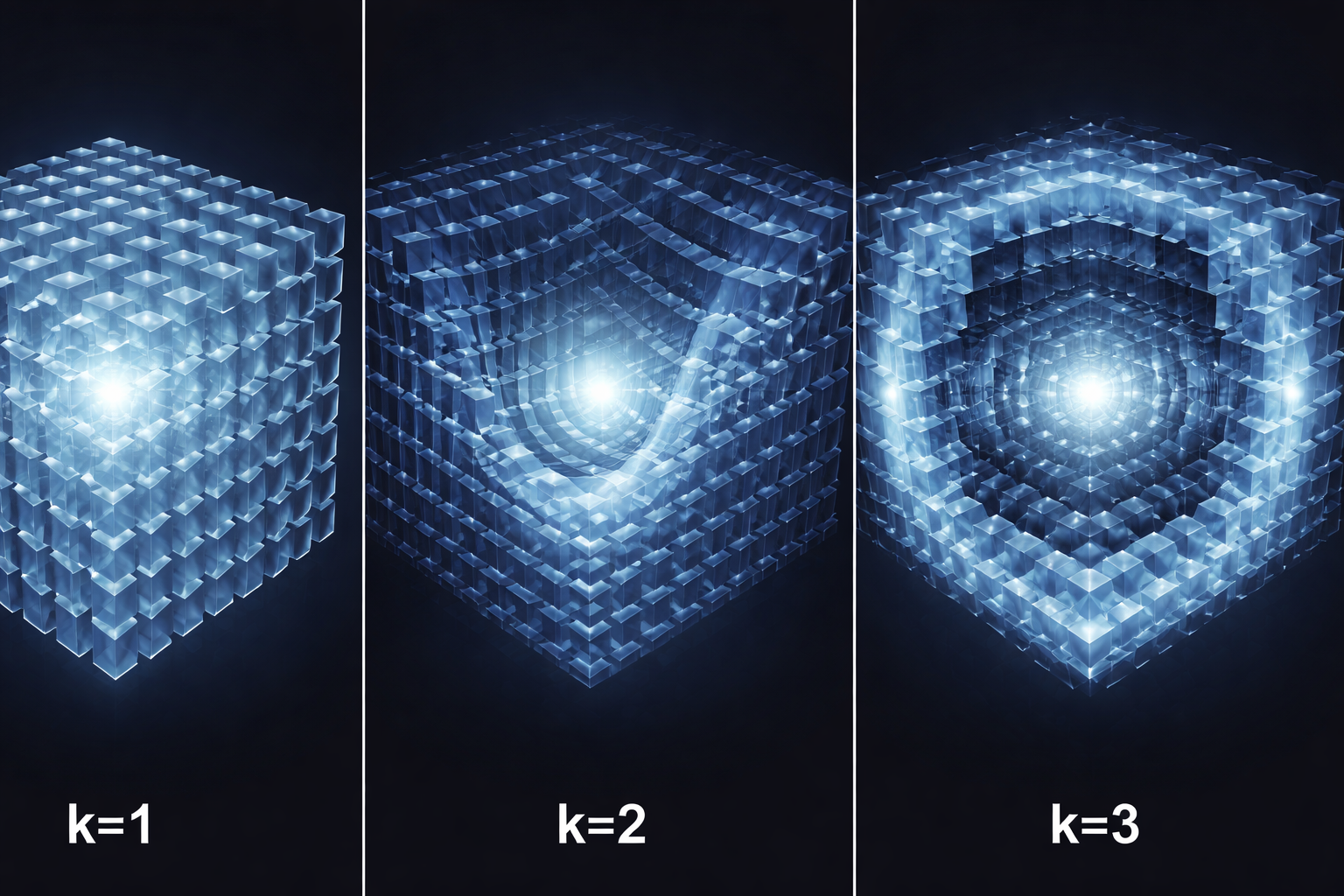
Three layers shown visually
- k = 1: conformal or scaling-like behavior
- k = 2: intrinsic curvature behavior
- k = 3: shell or interface structure linked to higher organization
This layered picture is part of how SOL organizes the transition from local cell interactions to larger physical effects.
Credibility and research status
Project status
SOL is maintained as an active theoretical research program with papers archived and expanded over time.
Access points
Read manuscripts, track development, and review the project through the papers page, GitHub repository, and ORCID profile.